Important
Traducerea este un efort al comunității, la care puteți să vă alăturați. În prezent, această pagină este tradusă 50.00%.
18.13. Ieșiri HTML
Notă
În această lecție învățăm cum administrează QGIS ieșirile în format HTML, care sunt utilizate pentru a produce text si grafică.
All the outputs we have produced so far were layers (whether raster or vector). However, some algorithms generate outputs in the form of text and graphics. All this outputs are wrapped in HTML files and displayed in the so–called Results viewer, which is another element of the processing framework.
Să vedem unul dintre acești algoritmi pentru a înțelege cum funcționează.
Open the project with the data to be used in this lesson and then open the Basic statistics for fields algorithm.
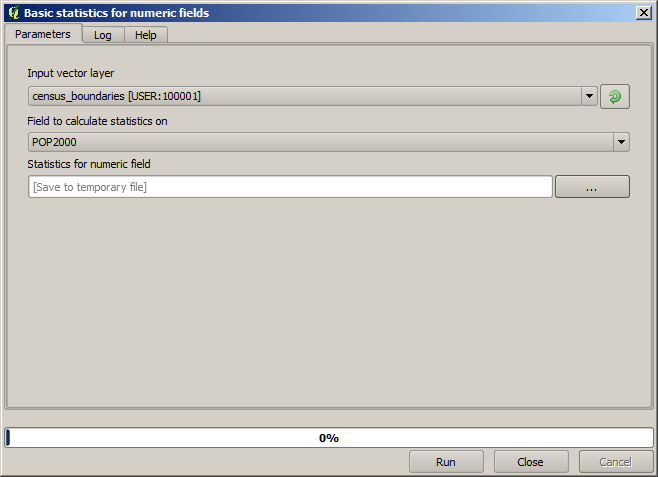
Algoritmul este destul de simplu, trebuind să selectați doar stratul de utilizat și unul din câmpurile sale (unul numeric). Ieșirea este de tip HTML, dar caseta corespunzătoare funcționează similar cu cea pentru o ieșire de tip vectorial sau raster. Puteți introduce o cale de fișier sau să o lăsați necompletată, pentru ca salvarea să aibă loc într-un fișier temporar. Totuși, în acest caz sunt acceptate doar extensiile html și htm, nefiind nici o modalitate de a modifica formatul de ieșire.
Run the algorithm selecting the only layer in the project as input, and
the POP2000 field, and a new dialog like the one shown next will appear
once the algorithm is executed and the parameters dialog is closed.
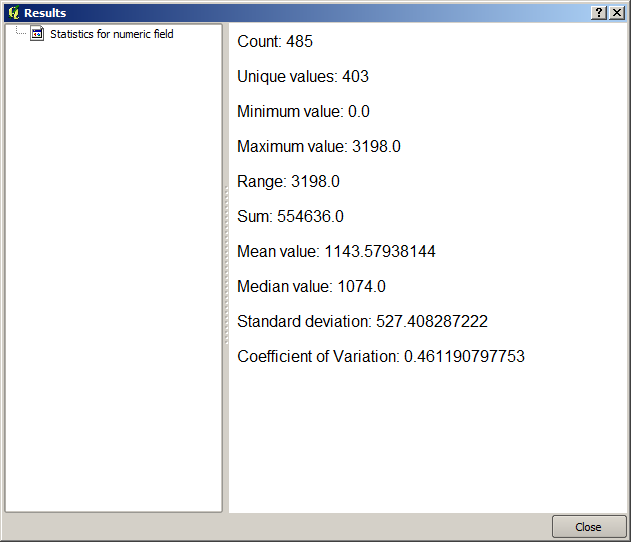
This is the Results viewer. It keeps all the HTML result generated during the current session, easily accessible, so you can check them quickly whenever you need it. As it happens with layers, if you have saved the output to a temporary file, it will be deleted once you close QGIS. If you have saved to a non-temporary path, the file will remain, but it will not appear in the Results viewer the next time you open QGIS.
Some algorithms generate text that cannot be divided into other more detailed outputs. That is the case if, for instance, the algorithm captures the text output from an external process. In other cases, the output is presented as text, but internally is divided into several smaller outputs, usually in the form of numeric values. The algorithm that we have just executed is one of them. Each one of those values is handled as a single output, and stored in a variable. This has no importance at all now, but once we move to the model designer, you will see that it will allow us to use those values as numeric inputs for other algorithms.